
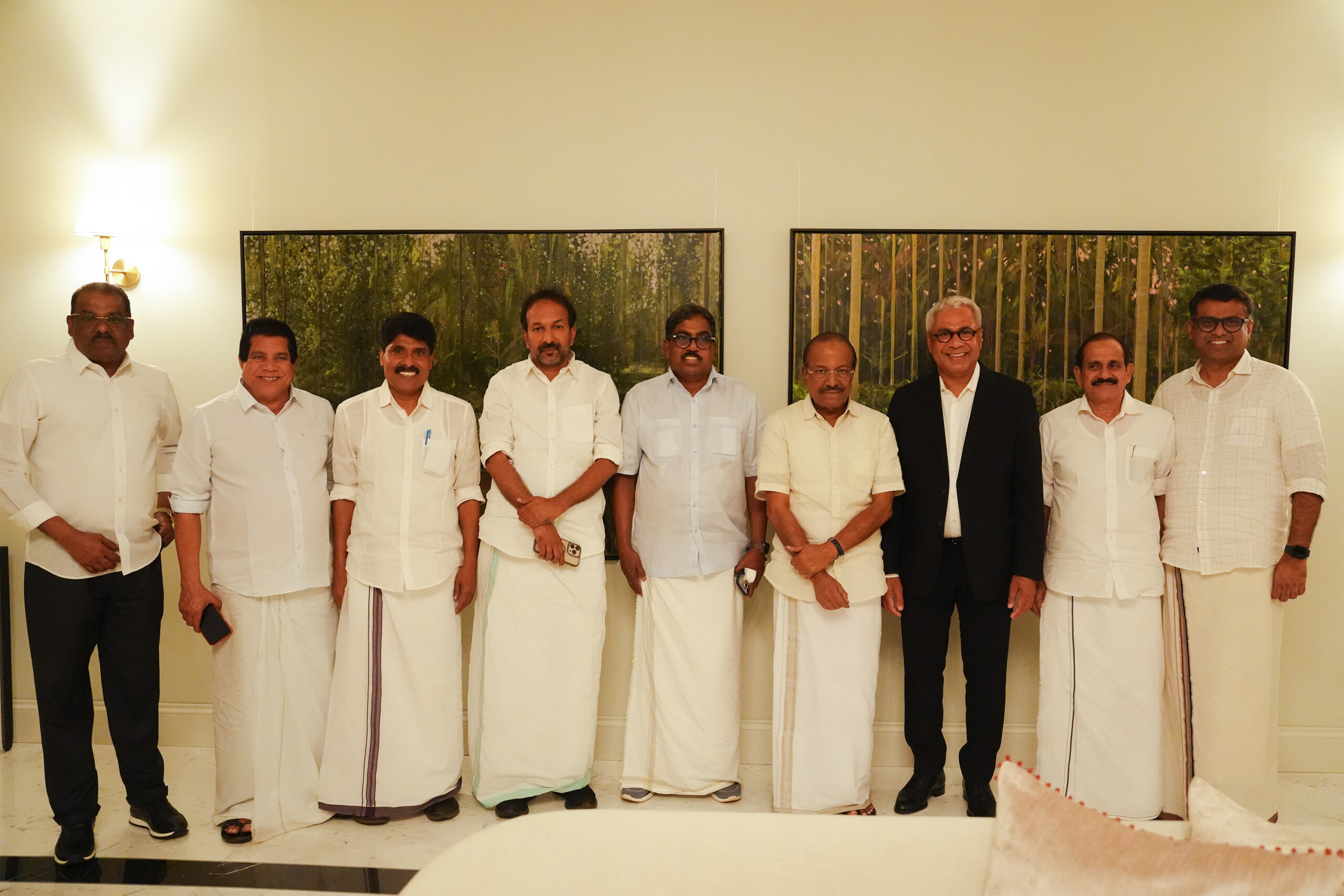
Kozhikode, Kerala, 10 August 2026: tulåh Clinical Wellness hosted a leadership dialogue on 7 August bringing together senior political leaders and government stakeholders to explore how Kerala can position itself as Asia’s Longevity Capital by 2036. The gathering was hosted by the Founder at tulåh- Mr. Faizal E. Kottikollon and focused on how knowledge, innovation and practical solutions developed through the tulåh project could contribute to broader healthcare, infrastructure, environmental and economic development across the state.
The event was attended by Shri P. K. Kunhalikutty, Minister for Industries & IT; Shri P. C. Vishnunath, Minister for Tourism; and Shri T. Siddique, Minister for Agriculture, Soil Survey and Soil Conservation. The discussion centred on Kerala 2036, a long-term vision for building on the state’s established strengths in authentic Ayurveda, medical expertise, biodiversity, favourable climate and a highly educated healthcare workforce.
At the centre of the dialogue was the idea that the value of innovation can extend beyond a single project when knowledge and practical solutions are shared. The tulåh model brings together advanced clinical medicine with Kerala’s Ayurvedic heritage, regenerative environmental design and community development, offering a framework that can be adapted across different sectors and verticals of care.
tulåh facade- shot by Gokull Rao Kadam
tulåh’s approach combines ancient healing systems, including Ayurveda, Yoga, Vedanta, Tibetan medicine and Traditional Chinese Medicine, with advanced diagnostics, regenerative medicine and modern clinical expertise. Its programmes are personalised through pre-arrival assessments and on-site diagnostics, interpreted through the tulåh Life Index™, which guides clinical pathways across prevention, optimisation, recovery and chronic care.
Beyond clinical wellness, the project has also generated practical solutions in areas including water management, regenerative construction, energy-efficient cooling, environmental surveying and community development. Geological surveying undertaken during tulåh’s development, for example, later informed the stabilisation of an adjacent national highway, demonstrating how research and innovation generated through a private project can contribute to wider public infrastructure planning.
The dialogue also examined the wider economic opportunity presented by the growing global demand for preventative healthcare and longevity. The Kerala Longevity Mission 2036 vision proposes that coordinated investment, supportive policy and public-private collaboration could help the state attract high-value international longevity travellers, create skilled employment, stimulate new industries and generate long-term economic value.
Speaking at the gathering, Faizal E. Kottikollon, Founder, tulåh Clinical Wellness, said: “Everything we have built at tulåh has taught us something, including the mistakes we made along the way. That knowledge becomes far more valuable when it is shared. If our experience can help shape better infrastructure, stronger communities, smarter investment and a healthier future for Kerala, then that is a success far greater than any single project. Our ambition is not simply to build tulåh, but to help build an ecosystem that positions Kerala as the global benchmark for integrative longevity.”
The gathering marked an important step in tulåh’s broader vision of demonstrating how a clinical wellness model can contribute to a wider ecosystem of healthcare advancement, sustainable tourism, infrastructure innovation and community development. With Kerala already recognised for its Ayurveda heritage and healthcare capabilities, the initiative seeks to build a new category around evidence-led, integrative longevity.