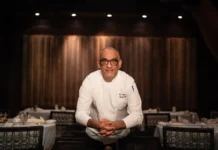
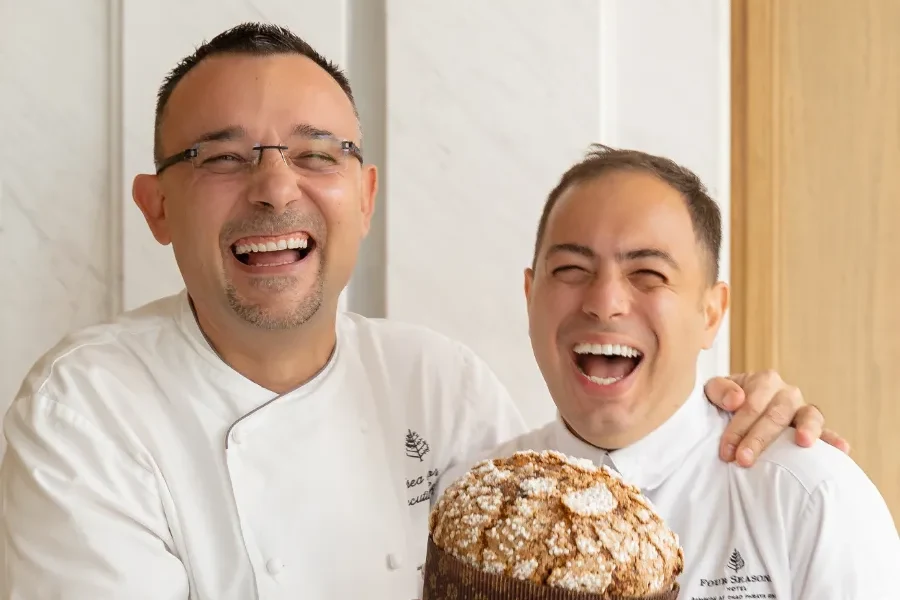
Chef Andrea Accordi was 19 when he first flew to Bangkok, sent from the Regent in London to lead a pasta promotion. He moved to Thailand a year later, learned to cook in a Thai kitchen in Phuket and learned to speak Thai, and then spent the next decades taking Italian cooking around the world: a Michelin star at 25 in Florence, the first Michelin star in Eastern Europe in Prague, and kitchens in St. Petersburg and Hong Kong. Today he is back where it began, as Executive Chef of Four Seasons Hotel Bangkok at Chao Phraya River, the hotel ranked third in The World’s 50 Best Hotels this year.
His Italian restaurant on the river, Riva del Fiume, has received Two Forchette from Gambero Rosso in both 2025 and 2026. As the hotel gets ready for Christmas, with an eight-course Christmas Eve dinner and an Italian Christmas Day brunch, we spoke to Chef Andrea over email about the dish he has never changed, the seven-year-old sourdough starter behind his panettone, Christmas in the northern Italian town of Nogara, and what he still learns from a young commis chef.
How Chef Andrea Accordi First Came to Bangkok
You first came to Bangkok at 19 for a pasta demonstration and moved here a year later. What drew you to Thailand then, and how did it feel to return as Executive Chef?
I was working at the Regent Hotel in London when one day, the Regent Bangkok contacted my Executive Chef looking for an Italian chef to lead a pasta promotion. I immediately raised my hand and said, “I want to go!”
My former Restaurant Chef had already moved to Malaysia, and seeing his journey made me curious about Asia. At 19, I was young, adventurous and eager to discover something completely different. What was supposed to be a pasta promotion turned into the beginning of an incredible chapter in my life.
Coming back to Thailand 28 years later felt like coming home. I have so many friendships and memories here. Thailand has shaped me not only as a chef but also as a person. To return as Executive Chef after all those years, and to have the opportunity to share my own Italian heritage in a country that means so much to me, was something very special.
Michelin Stars in Florence and Prague
You earned your first Michelin star at 25 in Florence, and your restaurant in Prague received the first Michelin star awarded in Eastern Europe. What did those years teach you about running a kitchen?
Those years taught me that talent alone is not enough. You need discipline, organisation and, above all, consistency. Cooking one exceptional meal is one thing; doing it every single day is a completely different challenge.
I also realised quite early in my career that you cannot achieve anything meaningful on your own. As a chef, you need to bring people together, keep them motivated and give them opportunities to grow. Leadership is about setting an example rather than simply telling people what to do.
Today, some of my greatest professional satisfaction comes from seeing chefs who once worked alongside me go on to lead their own kitchens and build successful careers. That, for me, is something to be very proud of.
How Prague, St. Petersburg and Hong Kong Shaped His Cooking
After Prague, St. Petersburg and Hong Kong, how has each city changed the way you cook?
Every place I have lived has left something with me. Working in Europe reinforced my appreciation for classical techniques, precision and discipline, while Asia opened my eyes to an entirely different world of ingredients, flavours and ways of cooking.
I am Italian, and that will always be at the heart of my cooking, but my experiences around the world have made me much more curious and open-minded. I don’t think my cooking would be what it is today had I stayed in Italy throughout my career.
At Riva del Fiume, particularly through my seasonal tasting menu, Un Viaggio, I have the opportunity to express some of those experiences. Some dishes are inspired by memories, others by ingredients that excite me at a particular time of year. It allows me to revisit familiar Italian flavours from a different perspective. In many ways, the menu is a reflection of my journey as a chef.
Thai Influences in His Italian Cooking
You trained in the Thai kitchen in Phuket and you speak Thai. How has Thai cooking found its way into your Italian food, perhaps in dishes like the pasta inspired by Thai boat noodles?
Thai cuisine was the first Asian cuisine I really immersed myself in, and it is something very close to my heart. My time working in a Thai kitchen in Phuket taught me so much about flavour.
What fascinates me about Thai cooking is how sweet, sour, salty, bitter and spicy elements can all come together in one dish without losing the character of the individual ingredients.
That understanding of balance has stayed with me throughout my career. My pasta inspired by Thai boat noodles is a good example. I am still cooking with an Italian mindset, but I am drawing on flavours and ideas that I have come to love in Thailand.
For me, it is not about combining two cuisines simply for the sake of doing something different. It has to make sense when you taste it, and it has to respect both cultures.
Leading the Restaurants at Four Seasons Hotel Bangkok
You oversee Riva del Fiume, Brasserie Palmier, Yu Ting Yuan and Chao Phraya Terrace, along with banqueting. How do you keep each kitchen’s identity while leading all of them?
I have been very fortunate to work with incredibly talented restaurant chefs since we opened the hotel. Each of them understands their cuisine and brings their own personality, ideas and way of expressing themselves through food.
Naturally, Riva del Fiume is particularly close to my heart because it represents the cuisine and culture I grew up with. But I take just as much pleasure in seeing our other restaurants develop their own identities, whether it is Cantonese cooking at Yu Ting Yuan, French brasserie classics at Brasserie Palmier or the Thai farm-to-table philosophy we celebrate at Chao Phraya Terrace.
I don’t believe every kitchen should be an extension of my own cooking style. My role is to give our chefs the freedom, support and resources to do what they do best. Of course, we all share the same expectations when it comes to quality and consistency, but I want each restaurant to have a personality of its own.
The Amatriciana Fagottelli at Riva del Fiume
Your amatriciana fagottelli has travelled with you from Villa La Vedetta to Prague, St. Petersburg, Hong Kong and now Bangkok. What is the story behind this dish, and why have you never changed it?
I created this dish when I was working at Villa La Vedetta in Florence, and it has been travelling with me ever since. You can still find it on the menu at Riva del Fiume today, and I haven’t changed the recipe, the flavours or the technique at all.
The idea was to take everything I love about a traditional amatriciana and capture it in a single bite. Instead of having the sauce around the pasta, I wanted all those familiar flavours to be inside. When you bite into the fagottello, everything comes together at once.
It is probably one of the dishes that best represents me as a chef. It respects a classic Italian recipe but presents it in a different way. I think it is important to understand tradition before trying to reinterpret it.
People still enjoy the dish after all these years, so why change something that works?
Italian and Thai Ingredients at Riva del Fiume
Riva del Fiume brings the traditions of different Italian regions to a terrace on the Chao Phraya. Which ingredients do you bring in from Italy, and what do you find closer to home in Thailand?
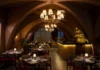
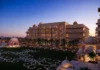
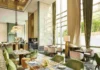
The idea behind Riva del Fiume is to bring a little piece of Italy to Bangkok. With its terraces overlooking the Chao Phraya River, it is a place where guests can settle in, enjoy good food and spend time together, much as we do in Italy.
From a culinary perspective, I want our guests to discover the diversity of Italy, from north to south. Italy is a relatively small country, yet the ingredients, recipes and traditions can change dramatically from one region to the next. That is something I never tire of exploring.
We bring in very particular regional ingredients from Italy, especially seasonal specialities that our guests may not have experienced before. I enjoy introducing people to products that tell a story about a particular region or time of year.
At the same time, we have spent years working closely with local farmers and producers in Thailand. Some of the tomatoes, herbs and vegetables we can find here today are just as good as, and in some cases even better than, what we could import.
I don’t believe everything has to come from Italy for a dish to be authentically Italian. It is about understanding the ingredients, respecting the recipe and knowing where to find the best produce. At Riva del Fiume, we are fortunate to have the best of both worlds.
What Makes a Great Pizza
Pizza has a special place at Riva del Fiume, from the wood oven to guest collaborations such as the one with Sestogusto Torino earlier this year. What makes a pizza truly great for you?
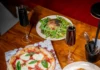
Pizza is such an important part of Italian culture, and I wanted it to have a proper place at Riva del Fiume. There is something wonderful about watching a pizza being prepared by hand, seeing it go into the wood-fired oven and then sharing it with the people around you.
For me, a great pizza always starts with the dough. You can have the most expensive toppings in the world, but if the dough is not right, it will never be a great pizza. The flour, fermentation, handling and baking all make a difference. The dough should be light, full of flavour and beautifully cooked.
Working with Massimiliano Prete of Sestogusto Torino was particularly interesting because it gave us an opportunity to explore another dimension of Italian pizza-making. Collaborations like these allow our guests to discover just how diverse and creative Italian cuisine can be.
I also believe that less is often more when it comes to toppings. A few really good ingredients, in the right proportions, can make an extraordinary pizza. The dough deserves just as much attention as whatever you put on top of it.
Christmas Traditions in Nogara, Italy
What did Christmas look like for you growing up in Nogara, and does any of it find its way onto your Christmas Eve menu this year?
Growing up in Nogara, Christmas was always about family and spending hours together around the table. There was no hurry to finish the meal. Food was the reason everyone came together, but it was really about enjoying each other’s company.
That is very much the spirit I want to bring to Christmas at Riva del Fiume. Italian hospitality is naturally generous. We enjoy sharing food, opening a good bottle of wine and spending time together, and Christmas is perhaps the most beautiful expression of that.
When creating our Christmas Eve menu, I think about the flavours I grew up with and the ingredients that remind me of winter in Italy. I may present them differently today, but I never want to lose the feeling behind them.
Of course, Christmas beside the Chao Phraya River looks rather different from Christmas in northern Italy, but that feeling of being together around a table is something we can recreate anywhere in the world.
The Four Seasons Bangkok Signature Panettone
You and Chef Andrea Bonaffini spent months refining the hotel’s Signature Panettone. What makes a great panettone, and what was the hardest part to get right in Bangkok’s climate?
When we started making our own panettone six years ago, I believe we were among the first hotels in Bangkok to do so. It was something we really wanted to get right because panettone is such an important part of Christmas in Italy.
Panettone is much more complicated than it looks. Everything begins with the lievito madre, our natural sourdough starter. Ours has been nurtured for more than seven years, and it needs constant care. Without a healthy starter, you simply cannot achieve the texture, aroma and depth of flavour that make a great panettone.
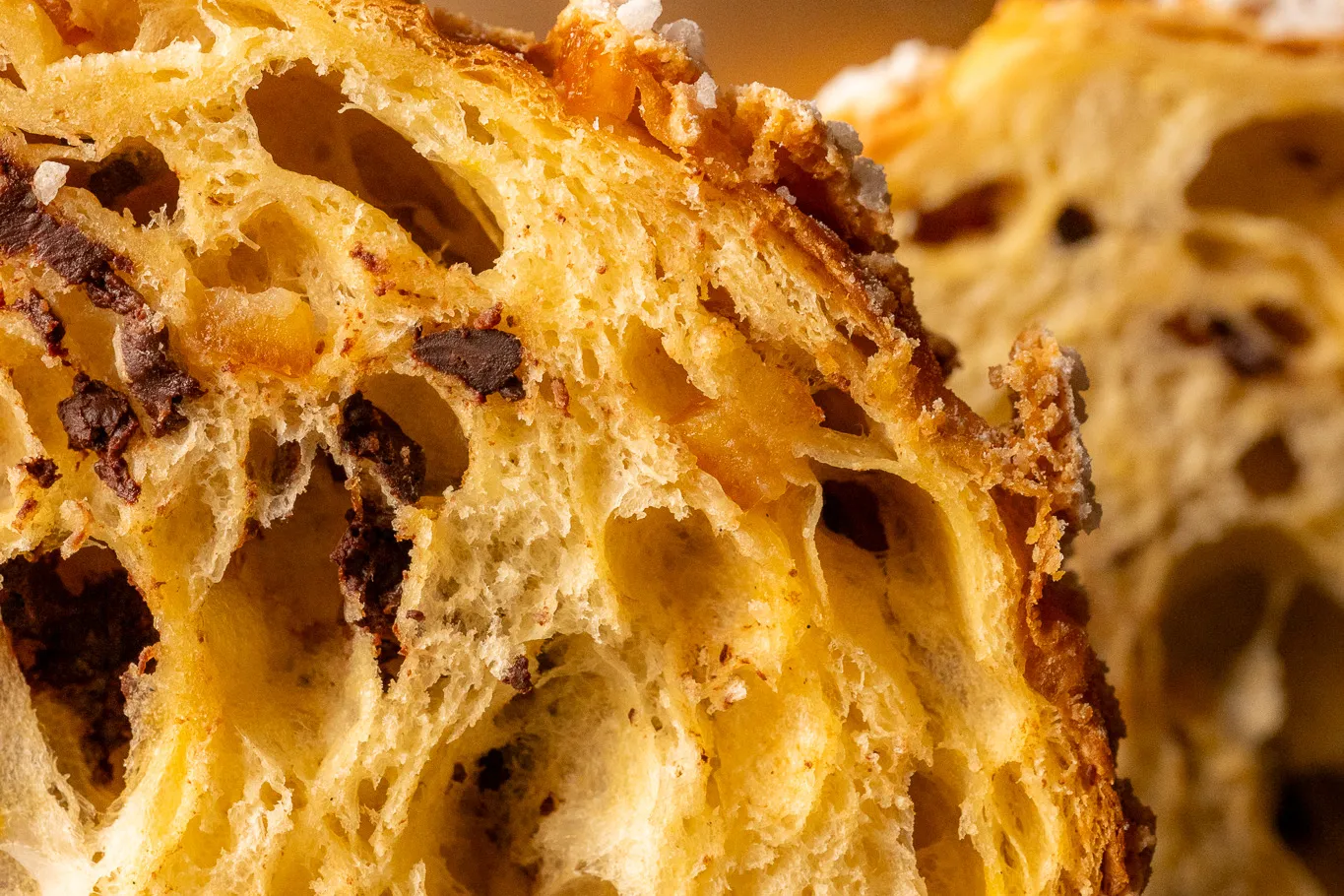
In Bangkok, the heat and humidity make fermentation particularly challenging. You have to pay very close attention to how the dough behaves and make adjustments throughout the process.
Chef Andrea Bonaffini and I have spent years working on our panettone, and every year he continues to experiment with flavours, techniques and fermentation. What I love about this process is that there is always something you can improve.
A great panettone should be beautifully light, fragrant, soft and full of flavour. I am particularly proud of what we have achieved this year. I think it is the best panettone we have made so far.
Christmas Day Brunch at Riva del Fiume
Our readers love a good brunch. What makes an Italian Christmas Day brunch different from any other, and which dish should guests save room for?
I always say that Christmas is not about how much you eat, but how well you eat. For me, it is about beautiful seasonal ingredients, comforting dishes and having enough time to enjoy everything with the people around you.
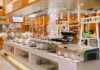
At Riva del Fiume, our Christmas Day brunch brings together many of the things I love about Italian dining, from fresh seafood and handmade pasta to beautifully prepared meats, pizzas fresh from the oven and traditional festive desserts. I want it to feel like a generous Italian family celebration rather than simply another brunch.
One dish I would never want to miss at Christmas is baby lamb cooked on the spit. It is a classic that immediately makes me think of the festive season.
For dessert, I would recommend our chestnut Mont Blanc. Chestnuts have such a wonderful association with winter in Europe. But if you ask me for one of my favourite ways to finish a Christmas meal, a warm slice of panettone with mascarpone sauce is very difficult to beat.
Vegetarian Dining at Riva del Fiume for Indian Travellers
Bangkok is one of the favourite getaways for Indian travellers. What do your Indian guests tend to love at Riva del Fiume, and what would you recommend for vegetarian guests?
From my experience, many of our Indian guests really appreciate the freshness of our ingredients and the flavours of our vegetable dishes, handmade pastas and pizzas.
Vegetables have always been an important part of Italian cooking. There are so many wonderful traditional Italian dishes that are naturally vegetarian, and I enjoy working with vegetables just as much as I do with meat or seafood.
At Riva del Fiume, our approach to seasonality gives us plenty of opportunities to explore different vegetables and ingredients throughout the year. Working with both Italian producers and local Thai farmers also gives us an incredible variety of produce to work with.
I would encourage vegetarian guests to explore our seasonal vegetable dishes, handmade pastas and vegetarian pizzas. Our chefs are also happy to discuss individual dietary preferences with guests.
For me, a vegetarian dish should never feel like a compromise. It should be something you would happily order whether you are vegetarian or not.
Four Seasons Bangkok in The World’s 50 Best Hotels
Four Seasons Bangkok was ranked third in The World’s 50 Best Hotels this year. What did that mean to you and your team in the kitchen?
It was a very proud moment for all of us. What makes this recognition particularly meaningful is knowing how many people contribute to it every day, many of whom our guests may never see.
In the kitchen, we have the privilege of being part of so many moments during a guest’s stay. It could be their first breakfast overlooking the Chao Phraya River, a long Italian lunch at Riva del Fiume, a special dinner with their family or an important celebration.
Every one of those moments matters. Food is such a personal part of travelling, and often it is the flavours and experiences around the table that people remember long after they return home.
I am very proud of my team and the dedication they bring to their work every day. This recognition belongs to them as much as it does to anyone else in the hotel.
Advice for Young Chefs
You have said that learning to cook is a never-ending story. What are you still learning today, and what advice would you give young chefs?
After more than three decades in professional kitchens, I still learn something new every day. Here in Thailand, I continue to discover local ingredients, spices, fermentation techniques and different ways of looking at food. I am also interested in how we can cook more sustainably while respecting the ingredients we use.
I learn a lot from my own team, too. Sometimes a young commis chef can show you something you have never thought about before. You can learn just as much from a market vendor as you can from another professional chef. You simply have to remain curious.
My advice to young chefs is to be patient and humble. Don’t be in too much of a hurry to do something extraordinary. First, learn how to make a good stock, how to cook pasta properly and how to prepare vegetables with care. Understand the basics and why things work.
Travel if you have the opportunity, taste everything you can and keep an open mind. A career in the kitchen takes time, discipline and a great deal of dedication.
Most importantly, cook with your heart. You can teach someone a technique, but the love for what you do has to come from within.
Riva del Fiume, Gambero Rosso and Life in Thailand
Is there anything else you would like to share?
One of the things I am particularly proud of is seeing Riva del Fiume evolve over the years. Receiving Two Forchette from Gambero Rosso in both 2025 and 2026 has been a wonderful recognition of the team’s work and our commitment to Italian cuisine, especially being so far from Italy.
But beyond the recognition, what matters most to me is how people feel when they dine with us. I want someone who grew up in Italy to recognise something familiar in our cooking, while someone discovering Italian cuisine for the first time feels curious to explore more.
Thailand has given me so much throughout my life and career. To be able to share a part of my own culture here, in a country that has become a second home to me, is something I find incredibly rewarding.
A recipe can carry generations of history, and a meal can become a memory that stays with someone for years. As chefs, I believe we have a responsibility to keep those traditions alive while allowing them to evolve.
At the end of the day, whether I am cooking in Italy, Thailand or anywhere else in the world, what makes me happiest is seeing people enjoy their food and their time together. That is why I became a chef, and it is still what motivates me today.
About Chef Andrea Accordi
Andrea Accordi is Executive Chef of Four Seasons Hotel Bangkok at Chao Phraya River, where he oversees the hotel’s restaurants, including Riva del Fiume, Brasserie Palmier, Yu Ting Yuan and Chao Phraya Terrace, as well as banqueting. Born in Nogara, Italy, he trained at the catering school I.P.S.A.R. in Bardolino and worked at the Regent Palace Hotel in London before first coming to Bangkok at 19 for a pasta promotion. At around 20 he moved to Le Royal Meridien Phuket, where he spent three years as a fine-dining chef in the Italian restaurant and his mornings in the Thai kitchen. He earned his first Michelin star in Florence at 25, and as Executive Chef of Four Seasons Hotel Prague, he saw its restaurant receive the first Michelin star awarded in Eastern Europe. He went on to open Four Seasons Hotel Lion Palace St. Petersburg in 2012 and spent nearly three years as Executive Chef of Four Seasons Hotel Hong Kong, whose restaurants held eight Michelin stars in the 2019 guide, before returning to Thailand. He speaks Italian, English and Thai.
Christmas at Riva del Fiume
Christmas Eve: an eight-course set dinner, THB 5,900 per adult and THB 2,900 per child aged 5 to 11, with optional wine pairings.
Christmas Day brunch: noon to 3 pm, with crudi, signature pastas, premium meats, fish and seafood, pizzas and festive panettone. THB 5,100 per adult and THB 2,900 per child aged 5 to 11, with optional free-flow beverage packages.
Where: Riva del Fiume Ristorante, Four Seasons Hotel Bangkok at Chao Phraya River, Charoen Krung Road, Bangkok
For the hotel’s full festive programme, from the Holiday Afternoon Tea to The Gilded Affair on New Year’s Eve, read our guide to Christmas and New Year’s Eve at Four Seasons Hotel Bangkok.
Frequently Asked Questions
Who is the Executive Chef of Four Seasons Hotel Bangkok?
Andrea Accordi is Executive Chef of Four Seasons Hotel Bangkok at Chao Phraya River. He oversees Riva del Fiume, Brasserie Palmier, Yu Ting Yuan, Chao Phraya Terrace and banqueting.
What is Riva del Fiume?
Riva del Fiume is the Italian restaurant at Four Seasons Hotel Bangkok, with terraces overlooking the Chao Phraya River. It received Two Forchette from Gambero Rosso in 2025 and 2026.
What is special about the Four Seasons Bangkok panettone?
The Signature Panettone is made with a natural sourdough starter, or lievito madre, that the kitchen has nurtured for more than seven years. Chef Andrea Accordi and Executive Pastry Chef Andrea Bonaffini have been making it for six years.
Is there a Christmas Day brunch at Four Seasons Bangkok?
Yes. Riva del Fiume serves an Italian Christmas Day brunch from noon to 3 pm, priced at THB 5,100 per adult and THB 2,900 per child aged 5 to 11.
Does Riva del Fiume have vegetarian options?
Yes. Chef Andrea recommends the seasonal vegetable dishes, handmade pastas and vegetarian pizzas, and the chefs are happy to discuss dietary preferences.
All images courtesy of Riva del Fiume at Four Seasons Bangkok.
Anju Anna Alex co-founded The Daily Brunch in 2016 with a simple belief: that a good meal tells you as much about a place as any guidebook. Her own idea of brunch began with Sunday appam and stew, shared with her family after church, and today she writes about hotels, chefs and travel from Canada, staying closely connected to India’s hospitality scene. A recognised voice in hospitality, she is a Canadian travel and hospitality writer and a leading content marketer and strategist. She holds an MSc from the London School of Economics and an MA from EFL University, and is a Fellow of the Royal Society of Arts.